RX — Densitometrie DEXA (MCB)
Sursă și prelucrare editorială
- Proveniență
- 1 referință declarată
- Fidelitatea preluării
- Nedocumentată
- Revizuire medicală
- Nedocumentată
Referințele declarate nu confirmă singure fidelitatea preluării sau aprobarea protocolului pentru utilizare locală.
Detalii despre surse și verificări
MCB Radiology — DEXA Guidelines
- Ediție / versiune a sursei
- Neprecizată
- Pagină / secțiune
- Pagini: 1–3
- Relația cu protocolul
- Document original importat integral; atribuirea autorilor rămâne cea din PDF.
- Data consultării
- 2026-09-27
Prelucrarea acestei pagini
- Mod de prelucrare
- Titlu și navigare în română; documentul sursă în engleză.; PDF original integral, previzualizare și text extras automat; fără completarea parametrilor clinici lipsă.
- Adaptări față de sursă
- Nedocumentate; absența evidenței nu confirmă o preluare integrală.
- Responsabil pentru prelucrare
- Neprecizat
- Atribuire existentă în pagină
- MCB Radiology (portalul sursă). Această atribuire nu identifică automat autorul sursei sau revizorul medical.
- Versiunea paginii
- mcb-1e9981efbc59
- Actualizare declarată a paginii
- 2026-09-27 — distinctă de revizuirea medicală.
Verificarea fidelității: Nedocumentată
Revizuirea medicală: Nedocumentată
Documentul original MCB — Densitometrie DEXA
Ghid · 3 pagini · consultat la 2026-09-27.
Descarcă PDF-ul integral · Sursa MCB · Catalogul MCB pentru această modalitate
Instrucțiunile, valorile și ilustrațiile din documentul original sunt păstrate în engleză. Titlul și navigarea sunt în română.
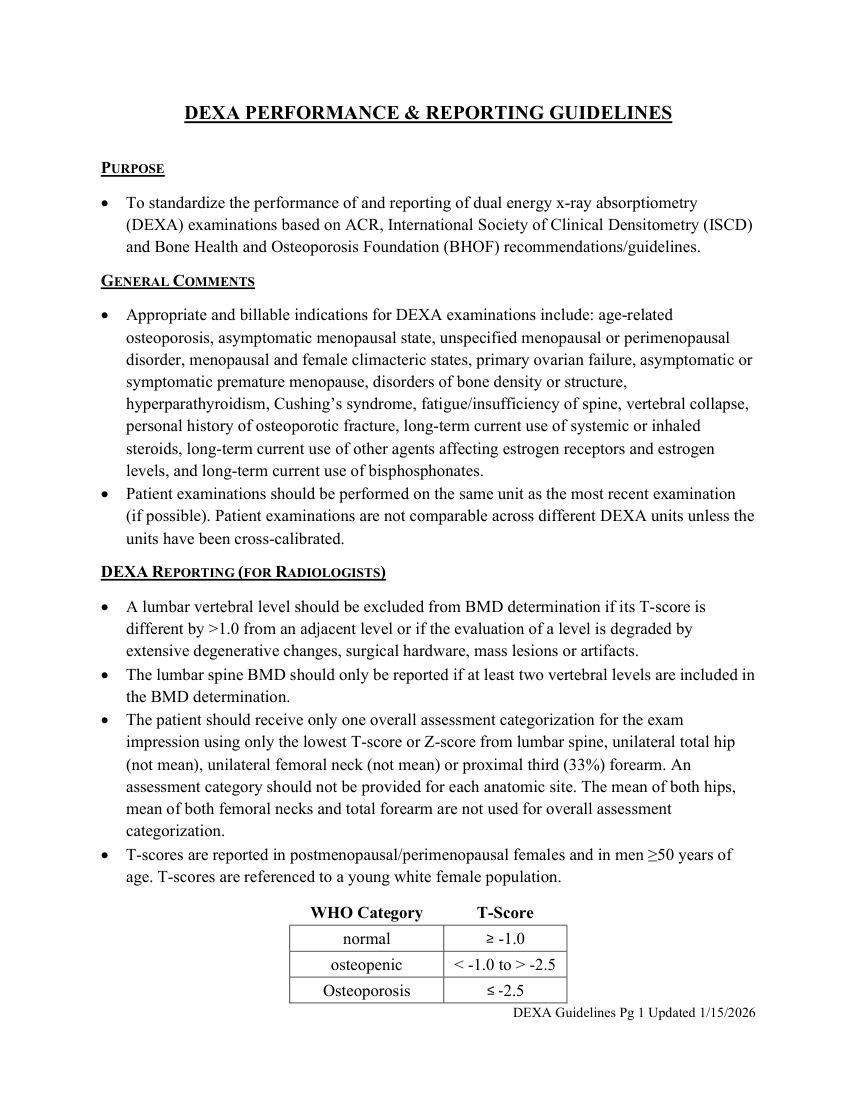
Pagina 1
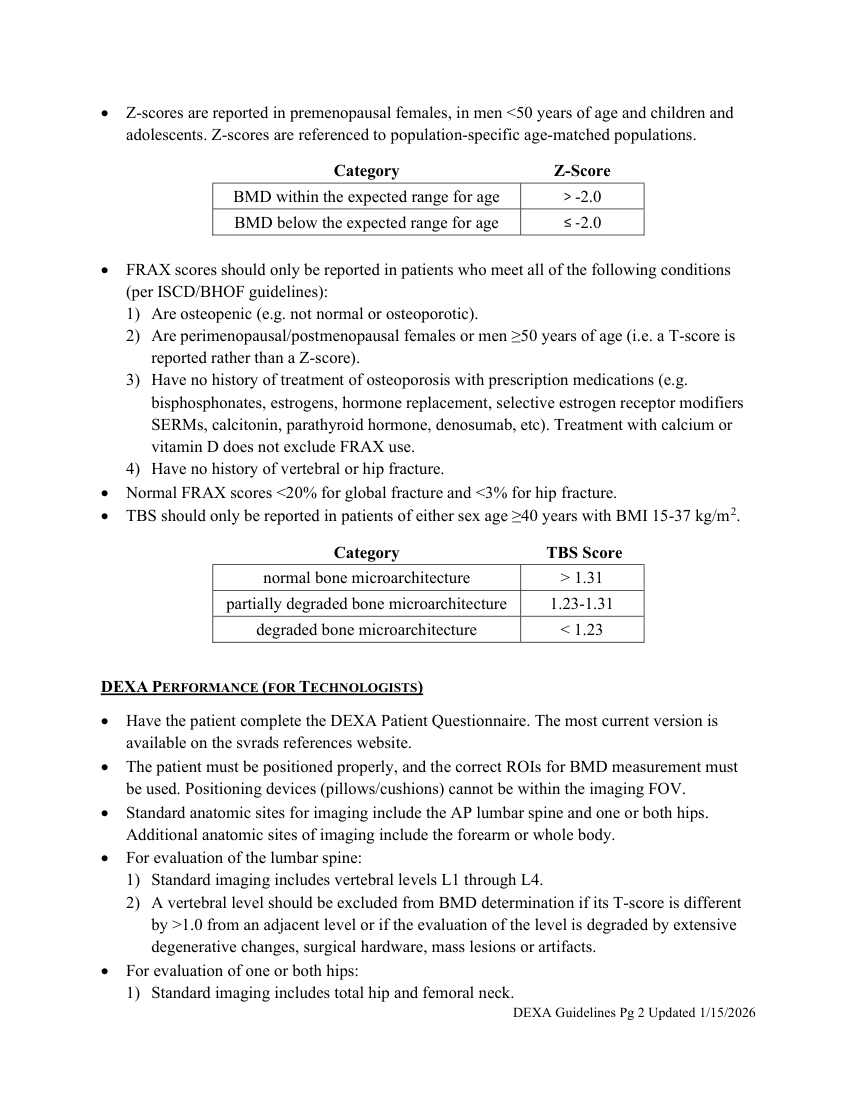
Pagina 2
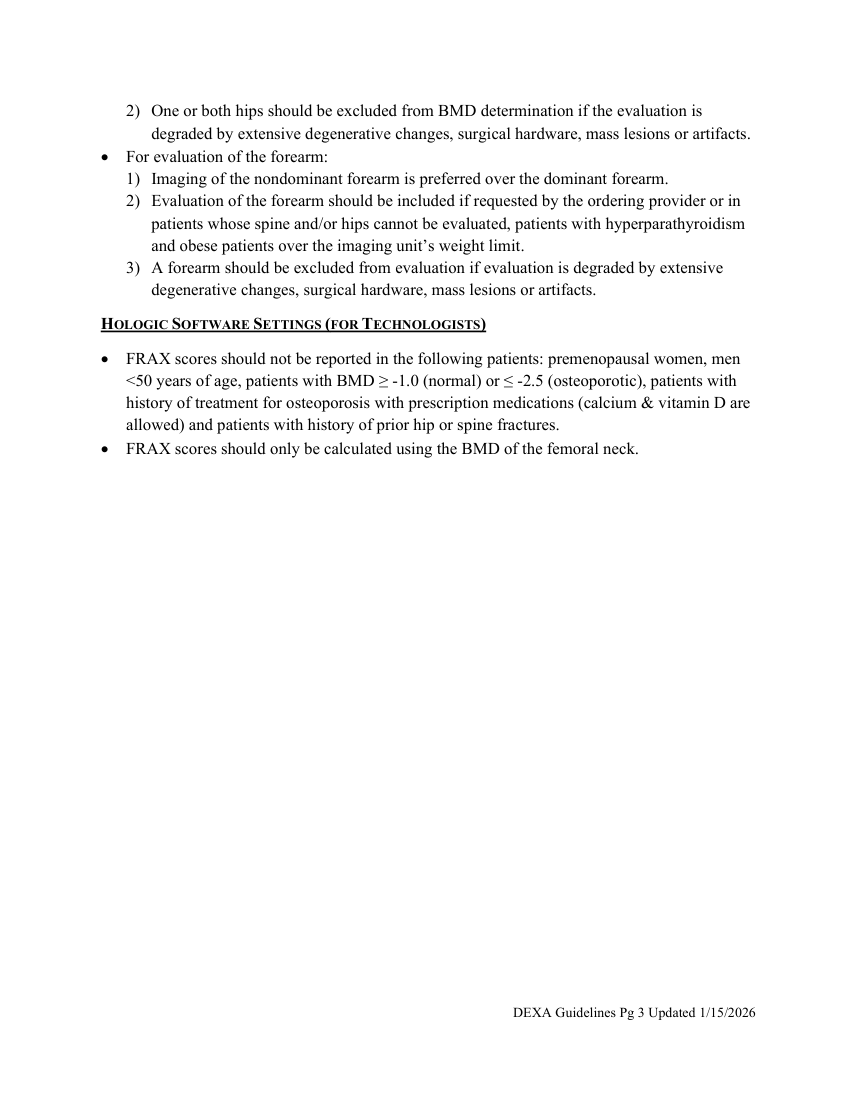
Pagina 3
Textul documentului original
Pagina 1 — text în engleză
PURPOSE
To standardize the performance of and reporting of dual energy x-ray absorptiometry (DEXA) examinations based on ACR, International Society of Clinical Densitometry (ISCD) and Bone Health and Osteoporosis Foundation (BHOF) recommendations/guidelines.
GENERAL COMMENTS
Appropriate and billable indications for DEXA examinations include: age-related osteoporosis, asymptomatic menopausal state, unspecified menopausal or perimenopausal disorder, menopausal and female climacteric states, primary ovarian failure, asymptomatic or symptomatic premature menopause, disorders of bone density or structure, hyperparathyroidism, Cushing’s syndrome, fatigue/insufficiency of spine, vertebral collapse, personal history of osteoporotic fracture, long-term current use of systemic or inhaled steroids, long-term current use of other agents affecting estrogen receptors and estrogen levels, and long-term current use of bisphosphonates. Patient examinations should be performed on the same unit as the most recent examination (if possible). Patient examinations are not comparable across different DEXA units unless the units have been cross-calibrated.
DEXA REPORTING (FOR RADIOLOGISTS) A lumbar vertebral level should be excluded from BMD determination if its T-score is different by >1.0 from an adjacent level or if the evaluation of a level is degraded by extensive degenerative changes, surgical hardware, mass lesions or artifacts. The lumbar spine BMD should only be reported if at least two vertebral levels are included in the BMD determination. The patient should receive only one overall assessment categorization for the exam impression using only the lowest T-score or Z-score from lumbar spine, unilateral total hip (not mean), unilateral femoral neck (not mean) or proximal third (33%) forearm. An assessment category should not be provided for each anatomic site. The mean of both hips, mean of both femoral necks and total forearm are not used for overall assessment categorization. T-scores are reported in postmenopausal/perimenopausal females and in men ≥50 years of age. T-scores are referenced to a young white female population. WHO Category T-Score normal ≥ -1.0 osteopenic < -1.0 to > -2.5 Osteoporosis ≤ -2.5 DEXA Guidelines Pg 1 Updated 1/15/2026
Pagina 2 — text în engleză
FRAX scores should only be reported in patients who meet all of the following conditions
(per ISCD/BHOF guidelines):
1) Are osteopenic (e.g. not normal or osteoporotic). 2) Are perimenopausal/postmenopausal females or men ≥50 years of age (i.e. a T-score is reported rather than a Z-score). 3) Have no history of treatment of osteoporosis with prescription medications (e.g. bisphosphonates, estrogens, hormone replacement, selective estrogen receptor modifiers SERMs, calcitonin, parathyroid hormone, denosumab, etc). Treatment with calcium or vitamin D does not exclude FRAX use. 4) Have no history of vertebral or hip fracture. Normal FRAX scores <20% for global fracture and <3% for hip fracture. TBS should only be reported in patients of either sex age ≥40 years with BMI 15-37 kg/m2. Category TBS Score normal bone microarchitecture > 1.31 partially degraded bone microarchitecture 1.23-1.31 degraded bone microarchitecture < 1.23
DEXA PERFORMANCE (FOR TECHNOLOGISTS) Have the patient complete the DEXA Patient Questionnaire. The most current version is available on the svrads references website. The patient must be positioned properly, and the correct ROIs for BMD measurement must be used. Positioning devices (pillows/cushions) cannot be within the imaging FOV. Standard anatomic sites for imaging include the AP lumbar spine and one or both hips. Additional anatomic sites of imaging include the forearm or whole body. For evaluation of the lumbar spine: 1) Standard imaging includes vertebral levels L1 through L4. 2) A vertebral level should be excluded from BMD determination if its T-score is different by >1.0 from an adjacent level or if the evaluation of the level is degraded by extensive degenerative changes, surgical hardware, mass lesions or artifacts. For evaluation of one or both hips: 1) Standard imaging includes total hip and femoral neck. DEXA Guidelines Pg 2 Updated 1/15/2026
Pagina 3 — text în engleză
FRAX scores should only be calculated using the BMD of the femoral neck.
DEXA Guidelines Pg 3 Updated 1/15/2026