Intervențional — Medicație și analize înaintea procedurilor (2025) (MCB)
Sursă și prelucrare editorială
- Proveniență
- 1 referință declarată
- Fidelitatea preluării
- Nedocumentată
- Revizuire medicală
- Nedocumentată
Referințele declarate nu confirmă singure fidelitatea preluării sau aprobarea protocolului pentru utilizare locală.
Detalii despre surse și verificări
MCB Radiology — 2025 Med & Lab Guidelines
- Ediție / versiune a sursei
- Neprecizată
- Pagină / secțiune
- Pagini: 1–3
- Relația cu protocolul
- Document original importat integral; atribuirea autorilor rămâne cea din PDF.
- Data consultării
- 2026-09-27
Prelucrarea acestei pagini
- Mod de prelucrare
- Titlu și navigare în română; documentul sursă în engleză.; PDF original integral, previzualizare și text extras automat; fără completarea parametrilor clinici lipsă.
- Adaptări față de sursă
- Nedocumentate; absența evidenței nu confirmă o preluare integrală.
- Responsabil pentru prelucrare
- Neprecizat
- Atribuire existentă în pagină
- MCB Radiology (portalul sursă). Această atribuire nu identifică automat autorul sursei sau revizorul medical.
- Versiunea paginii
- mcb-8a7c4e88dbe7
- Actualizare declarată a paginii
- 2026-09-27 — distinctă de revizuirea medicală.
Verificarea fidelității: Nedocumentată
Revizuirea medicală: Nedocumentată
Documentul original MCB — Medicație și analize înaintea procedurilor (2025)
Ghid procedural · 3 pagini · consultat la 2026-09-27.
Descarcă PDF-ul integral · Sursa MCB · Catalogul MCB pentru această modalitate
Instrucțiunile, valorile și ilustrațiile din documentul original sunt păstrate în engleză. Titlul și navigarea sunt în română.
Pagina 1
Pagina 2
Pagina 3
Textul documentului original
Pagina 1 — text în engleză
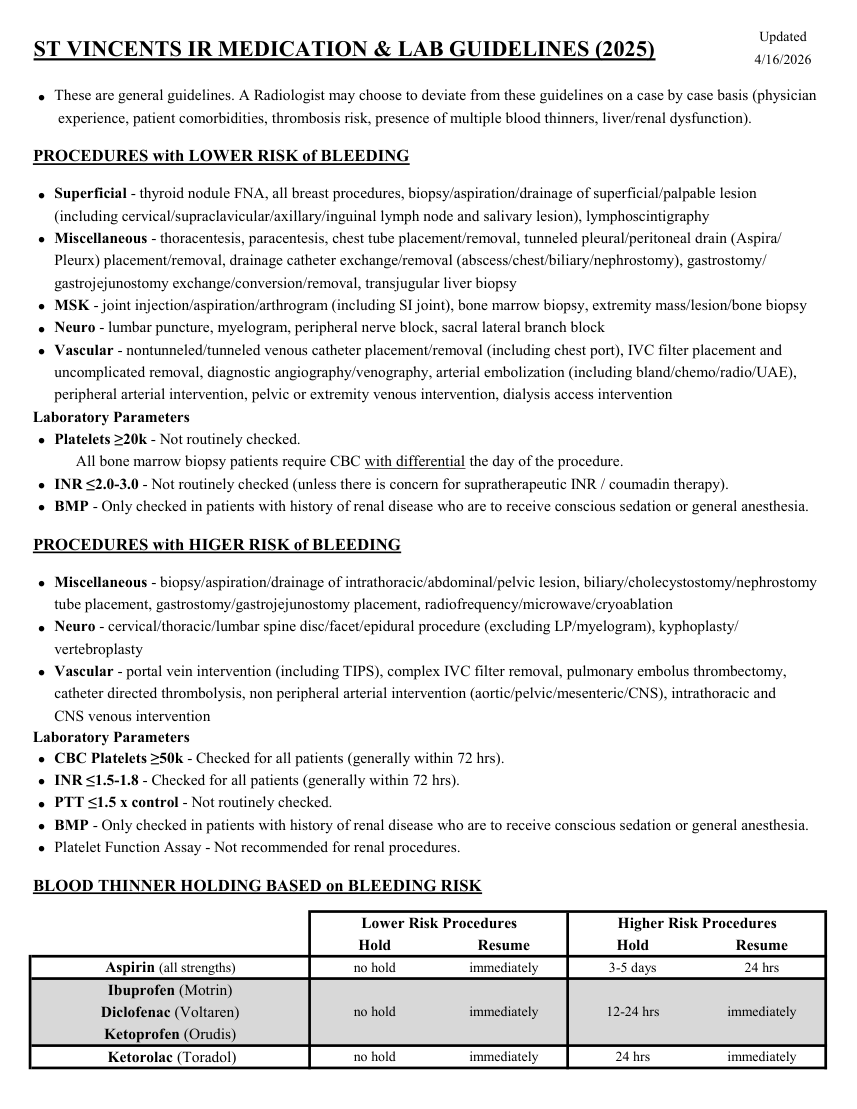
Updated 4/16/2026 ST VINCENTS IR MEDICATION & LAB GUIDELINES (2025) experience, patient comorbidities, thrombosis risk, presence of multiple blood thinners, liver/renal dysfunction). These are general guidelines. A Radiologist may choose to deviate from these guidelines on a case by case basis (physician PROCEDURES with LOWER RISK of BLEEDING Superficial - thyroid nodule FNA, all breast procedures, biopsy/aspiration/drainage of superficial/palpable lesion (including cervical/supraclavicular/axillary/inguinal lymph node and salivary lesion), lymphoscintigraphy gastrojejunostomy exchange/conversion/removal, transjugular liver biopsy Pleurx) placement/removal, drainage catheter exchange/removal (abscess/chest/biliary/nephrostomy), gastrostomy/ Miscellaneous - thoracentesis, paracentesis, chest tube placement/removal, tunneled pleural/peritoneal drain (Aspira/ Neuro - lumbar puncture, myelogram, peripheral nerve block, sacral lateral branch block MSK - joint injection/aspiration/arthrogram (including SI joint), bone marrow biopsy, extremity mass/lesion/bone biopsy uncomplicated removal, diagnostic angiography/venography, arterial embolization (including bland/chemo/radio/UAE),
Vascular - nontunneled/tunneled venous catheter placement/removal (including chest port), IVC filter placement and peripheral arterial intervention, pelvic or extremity venous intervention, dialysis access intervention Laboratory Parameters Platelets ≥20k - Not routinely checked. All bone marrow biopsy patients require CBC with differential the day of the procedure. BMP - Only checked in patients with history of renal disease who are to receive conscious sedation or general anesthesia. INR ≤2.0-3.0 - Not routinely checked (unless there is concern for supratherapeutic INR / coumadin therapy). PROCEDURES with HIGER RISK of BLEEDING Miscellaneous - biopsy/aspiration/drainage of intrathoracic/abdominal/pelvic lesion, biliary/cholecystostomy/nephrostomy tube placement, gastrostomy/gastrojejunostomy placement, radiofrequency/microwave/cryoablation Neuro - cervical/thoracic/lumbar spine disc/facet/epidural procedure (excluding LP/myelogram), kyphoplasty/ vertebroplasty catheter directed thrombolysis, non peripheral arterial intervention (aortic/pelvic/mesenteric/CNS), intrathoracic and Vascular - portal vein intervention (including TIPS), complex IVC filter removal, pulmonary embolus thrombectomy, CNS venous intervention Laboratory Parameters PTT ≤1.5 x control - Not routinely checked. INR ≤1.5-1.8 - Checked for all patients (generally within 72 hrs). CBC Platelets ≥50k - Checked for all patients (generally within 72 hrs). BMP - Only checked in patients with history of renal disease who are to receive conscious sedation or general anesthesia. Platelet Function Assay - Not recommended for renal procedures. BLOOD THINNER HOLDING BASED on BLEEDING RISK Lower Risk Procedures Higher Risk Procedures Hold Resume Hold Resume no hold immediately 3-5 days 24 hrs Aspirin (all strengths) Ibuprofen (Motrin) no hold immediately 12-24 hrs immediately Diclofenac (Voltaren) no hold immediately 24 hrs Ketoprofen (Orudis) Ketorolac (Toradol) immediately
Vascular - nontunneled/tunneled venous catheter placement/removal (including chest port), IVC filter placement and peripheral arterial intervention, pelvic or extremity venous intervention, dialysis access intervention Laboratory Parameters Platelets ≥20k - Not routinely checked. All bone marrow biopsy patients require CBC with differential the day of the procedure. BMP - Only checked in patients with history of renal disease who are to receive conscious sedation or general anesthesia. INR ≤2.0-3.0 - Not routinely checked (unless there is concern for supratherapeutic INR / coumadin therapy). PROCEDURES with HIGER RISK of BLEEDING Miscellaneous - biopsy/aspiration/drainage of intrathoracic/abdominal/pelvic lesion, biliary/cholecystostomy/nephrostomy tube placement, gastrostomy/gastrojejunostomy placement, radiofrequency/microwave/cryoablation Neuro - cervical/thoracic/lumbar spine disc/facet/epidural procedure (excluding LP/myelogram), kyphoplasty/ vertebroplasty catheter directed thrombolysis, non peripheral arterial intervention (aortic/pelvic/mesenteric/CNS), intrathoracic and Vascular - portal vein intervention (including TIPS), complex IVC filter removal, pulmonary embolus thrombectomy, CNS venous intervention Laboratory Parameters PTT ≤1.5 x control - Not routinely checked. INR ≤1.5-1.8 - Checked for all patients (generally within 72 hrs). CBC Platelets ≥50k - Checked for all patients (generally within 72 hrs). BMP - Only checked in patients with history of renal disease who are to receive conscious sedation or general anesthesia. Platelet Function Assay - Not recommended for renal procedures. BLOOD THINNER HOLDING BASED on BLEEDING RISK Lower Risk Procedures Higher Risk Procedures Hold Resume Hold Resume no hold immediately 3-5 days 24 hrs Aspirin (all strengths) Ibuprofen (Motrin) no hold immediately 12-24 hrs immediately Diclofenac (Voltaren) no hold immediately 24 hrs Ketoprofen (Orudis) Ketorolac (Toradol) immediately
Pagina 2 — text în engleză
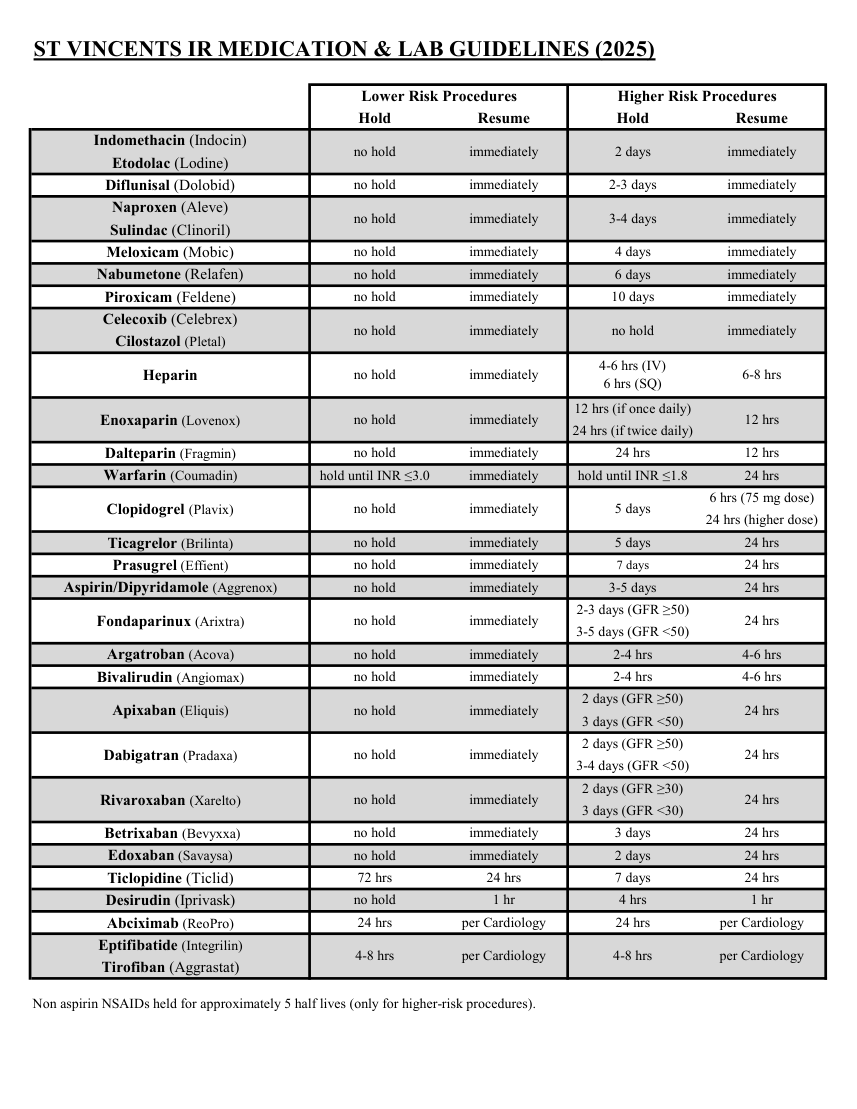
ST VINCENTS IR MEDICATION & LAB GUIDELINES (2025) Lower Risk Procedures Higher Risk Procedures Hold Resume Hold Resume Indomethacin (Indocin) 2 days immediately no hold immediately Etodolac (Lodine) 2-3 days immediately no hold immediately Diflunisal (Dolobid) Naproxen (Aleve) immediately 3-4 days immediately no hold Sulindac (Clinoril) immediately 4 days immediately no hold Meloxicam (Mobic) immediately no hold immediately 6 days Nabumetone (Relafen) 10 days immediately no hold immediately Piroxicam (Feldene) Celecoxib (Celebrex) no hold immediately no hold immediately Cilostazol (Pletal) no hold 6-8 hrs 4-6 hrs (IV)
Heparin 6 hrs (SQ) immediately 12 hrs (if once daily) 12 hrs Enoxaparin (Lovenox) 24 hrs (if twice daily) no hold immediately no hold immediately 24 hrs 12 hrs Dalteparin (Fragmin) hold until INR ≤3.0 immediately hold until INR ≤1.8 24 hrs Warfarin (Coumadin) 6 hrs (75 mg dose) Clopidogrel (Plavix) 24 hrs (higher dose) no hold immediately 5 days no hold immediately 5 days 24 hrs Ticagrelor (Brilinta) no hold immediately 7 days 24 hrs Prasugrel (Effient) no hold immediately 3-5 days 24 hrs Aspirin/Dipyridamole (Aggrenox) 2-3 days (GFR ≥50) no hold immediately Fondaparinux (Arixtra) 24 hrs 3-5 days (GFR <50) no hold immediately 2-4 hrs 4-6 hrs Argatroban (Acova) no hold immediately 2-4 hrs 4-6 hrs Bivalirudin (Angiomax) 2 days (GFR ≥50) no hold immediately 24 hrs Apixaban (Eliquis) 3 days (GFR <50) 2 days (GFR ≥50) no hold immediately Dabigatran (Pradaxa) 24 hrs 3-4 days (GFR <50) 2 days (GFR ≥30) no hold immediately Rivaroxaban (Xarelto) 24 hrs 3 days (GFR <30) no hold immediately 3 days 24 hrs Betrixaban (Bevyxxa) no hold immediately 2 days 24 hrs 72 hrs 24 hrs 7 days 24 hrs Ticlopidine (Ticlid) Edoxaban (Savaysa) no hold 1 hr 4 hrs 1 hr Desirudin (Iprivask) 24 hrs per Cardiology 24 hrs per Cardiology Abciximab (ReoPro) Eptifibatide (Integrilin) 4-8 hrs per Cardiology 4-8 hrs per Cardiology Tirofiban (Aggrastat) Non aspirin NSAIDs held for approximately 5 half lives (only for higher-risk procedures).
Heparin 6 hrs (SQ) immediately 12 hrs (if once daily) 12 hrs Enoxaparin (Lovenox) 24 hrs (if twice daily) no hold immediately no hold immediately 24 hrs 12 hrs Dalteparin (Fragmin) hold until INR ≤3.0 immediately hold until INR ≤1.8 24 hrs Warfarin (Coumadin) 6 hrs (75 mg dose) Clopidogrel (Plavix) 24 hrs (higher dose) no hold immediately 5 days no hold immediately 5 days 24 hrs Ticagrelor (Brilinta) no hold immediately 7 days 24 hrs Prasugrel (Effient) no hold immediately 3-5 days 24 hrs Aspirin/Dipyridamole (Aggrenox) 2-3 days (GFR ≥50) no hold immediately Fondaparinux (Arixtra) 24 hrs 3-5 days (GFR <50) no hold immediately 2-4 hrs 4-6 hrs Argatroban (Acova) no hold immediately 2-4 hrs 4-6 hrs Bivalirudin (Angiomax) 2 days (GFR ≥50) no hold immediately 24 hrs Apixaban (Eliquis) 3 days (GFR <50) 2 days (GFR ≥50) no hold immediately Dabigatran (Pradaxa) 24 hrs 3-4 days (GFR <50) 2 days (GFR ≥30) no hold immediately Rivaroxaban (Xarelto) 24 hrs 3 days (GFR <30) no hold immediately 3 days 24 hrs Betrixaban (Bevyxxa) no hold immediately 2 days 24 hrs 72 hrs 24 hrs 7 days 24 hrs Ticlopidine (Ticlid) Edoxaban (Savaysa) no hold 1 hr 4 hrs 1 hr Desirudin (Iprivask) 24 hrs per Cardiology 24 hrs per Cardiology Abciximab (ReoPro) Eptifibatide (Integrilin) 4-8 hrs per Cardiology 4-8 hrs per Cardiology Tirofiban (Aggrastat) Non aspirin NSAIDs held for approximately 5 half lives (only for higher-risk procedures).
Pagina 3 — text în engleză
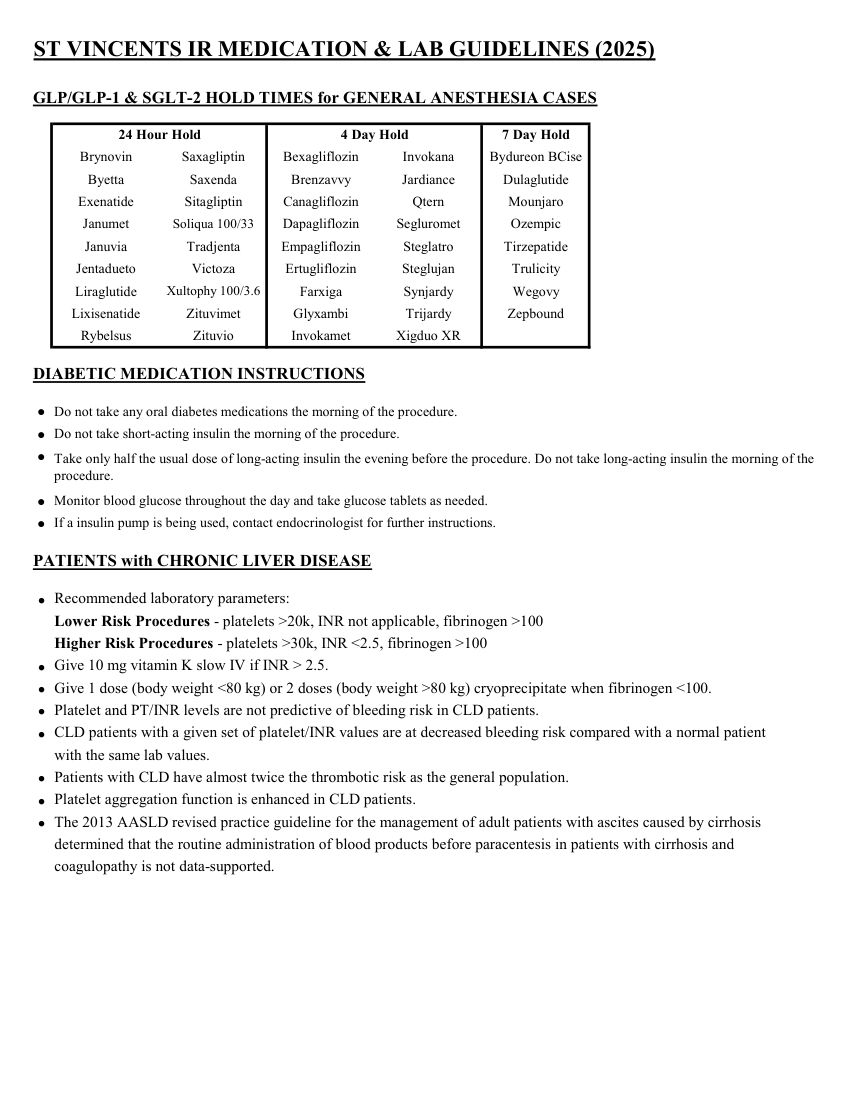
ST VINCENTS IR MEDICATION & LAB GUIDELINES (2025) GLP/GLP-1 & SGLT-2 HOLD TIMES for GENERAL ANESTHESIA CASES 24 Hour Hold 4 Day Hold 7 Day Hold Brynovin Saxagliptin Bexagliflozin Invokana Bydureon BCise Byetta Saxenda Brenzavvy Jardiance Dulaglutide Exenatide Sitagliptin Canagliflozin Qtern Mounjaro Janumet Soliqua 100/33 Dapagliflozin Segluromet Ozempic Januvia Tradjenta Empagliflozin Steglatro Tirzepatide Jentadueto Victoza Ertugliflozin Steglujan Trulicity Liraglutide Xultophy 100/3.6 Farxiga Synjardy Wegovy Lixisenatide Zituvimet Glyxambi Trijardy Zepbound Rybelsus Zituvio Invokamet Xigduo XR DIABETIC MEDICATION INSTRUCTIONS Do not take any oral diabetes medications the morning of the procedure. ● Do not take short-acting insulin the morning of the procedure. ● ● Take only half the usual dose of long-acting insulin the evening before the procedure. Do not take long-acting insulin the morning of the procedure. Monitor blood glucose throughout the day and take glucose tablets as needed. ● If a insulin pump is being used, contact endocrinologist for further instructions. ● PATIENTS with CHRONIC LIVER DISEASE Higher Risk Procedures - platelets >30k, INR <2.5, fibrinogen >100 Lower Risk Procedures - platelets >20k, INR not applicable, fibrinogen >100 Recommended laboratory parameters: Give 10 mg vitamin K slow IV if INR > 2.5. Give 1 dose (body weight <80 kg) or 2 doses (body weight >80 kg) cryoprecipitate when fibrinogen <100. Platelet and PT/INR levels are not predictive of bleeding risk in CLD patients. Platelet aggregation function is enhanced in CLD patients. Patients with CLD have almost twice the thrombotic risk as the general population. with the same lab values. CLD patients with a given set of platelet/INR values are at decreased bleeding risk compared with a normal patient coagulopathy is not data-supported. determined that the routine administration of blood products before paracentesis in patients with cirrhosis and The 2013 AASLD revised practice guideline for the management of adult patients with ascites caused by cirrhosis